
When and how to start complementary feeding?
When and how should we start complementary feeding?
Starting complementary feeding is always a major milestone in the life of the baby and the parents. Especially first-time mothers (and fathers!) are full of questions, doubts, and fears at this time. Naturally, the task is not made easier by the fact that nowadays there is a lot of conflicting information and trends circulating on the internet regarding complementary feeding, making it easy to become even more uncertain about what to do.
In my experience, it can already give greater confidence if we think through the framework: if the whys, the hows, the tools, and the possibilities are assessed, we already have some support under our arms!
As a first step, it is worth turning to those who are more experienced than us! Although every little child is different, and - fortunately - official recommendations and complementary feeding charts also change, it may be worth getting information from family and friends! Of course, handle the advice received with caution: partly because of the aforementioned changes, and partly because if we want to carry out something too much according to expectations, it is certain that the opposite will happen. But that's the beauty of life with small children, isn't it?
If we have informed ourselves a bit on the topic - either from acquaintances or on the ManóMenü pages - then it is worth preparing for complementary feeding with the following steps:
Step 1 – Make sure your baby is ready for complementary feeding!
It doesn't sound too complicated... but how can we really be sure that it's time to give our little one something other than breast milk/formula?
According to the 2017 recommendation of the European Society for Pediatric Gastroenterology, Hepatology and Nutrition (ESPGHAN), it is not recommended to start complementary feeding before the 4th month (17 weeks of age), but it also mentions that it should not be postponed beyond the 6th month (26 weeks).
In our country, the most common recommendation is to wait until the baby is 6 months old before starting complementary feeding.
Complementary feeding for premature babies (born before 37 weeks of gestation) can be unique, so always consult with the doctor(s) treating the baby before starting!
At the same time, as we know, every baby is different; so it may be worth paying attention to other visible signs, such as:
- The baby's neck muscles are sufficiently strong, and they hold their head steadily.
- They sit securely with help, and can stay in a sitting position when held in the lap.
- They reach for objects, grab them, and put them in their mouth.
- They make chewing movements.
- They watch us eat and visibly would like to taste the food.
Important: If we feel that our baby is ready for complementary feeding before 6 months of age, always consult with the health visitor or our doctor before actually starting!
Step 2 – Consider which feeding method/approach you prefer!
We can choose from several different alternatives:
Spoon-fed/Pureed feeding – starting with purees, which gradually become more textured, reaching hand-held bites by 9-10 months of age.
BLW – (Baby Led Weaning) – feeding starts with non-pureed, chunky foods; the most important aspect is relying on the baby for feeding and involving them in the meal if we are eating ourselves.
BLISS – (Baby-Led Introduction of SolidS) – very similar to the BLW method, but emphasizes the importance of starting feeding with foods high in iron, zinc, and calories.
Step 3 – Plan the circumstances!
Take stock of our tools and acquire what might be missing! In addition to a high chair (where the baby can sit upright and their feet are supported), unbreakable plates (plastic, silicone, or bamboo), spoons, and bibs, you may need a blender, washable mats, freezer trays (for purees), and storage boxes!
Consider which time of day you would like to try feeding for the first time! The most ideal time is when the little one is not ravenous, because if the baby is impatiently waiting for milk and we offer puree or soft vegetable pieces instead, it will likely result in a strong reaction. Therefore, the time after breakfast but before lunch seems most suitable, not to mention that this way we can notice any potential allergic symptoms to the newly introduced food earlier.

Step 4 - Choose the first foods!
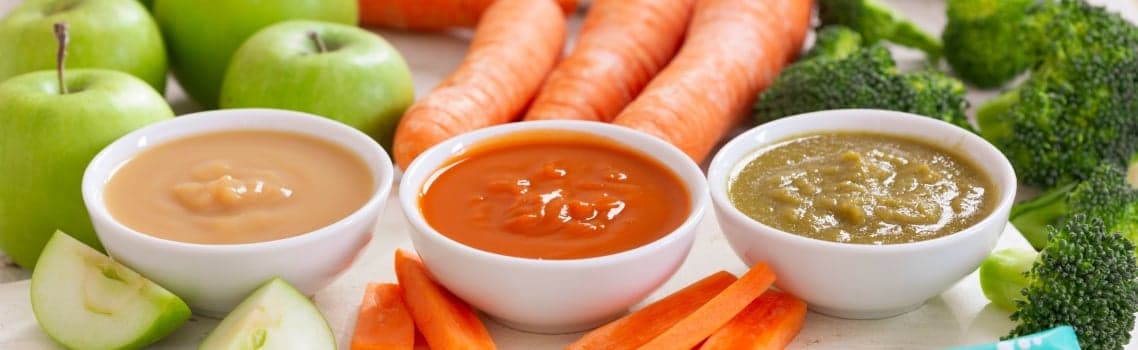
If you decide on spoon-feeding/pureeing, it is advisable to first offer the baby foods that do not have particularly strong flavors and can be mixed in various ways with other ingredients later on.
If you are following the BLW method, it is worth starting with soft fruits or vegetables that can be steamed until soft.
Interesting fact: According to a European survey (in which 412 mothers were asked what they gave their babies for the first time), the following foods are most often presented to little ones first:
- 21% apple
- 14% banana
- 6% oatmeal
- 5% pear
- 4% sweet potato
- 2% potato
- 33% other foods
Step 5 - Prepare and cook the food properly!
- Thoroughly wash the vegetables and fruits you want to use!
- Peel and cut them into larger pieces!
- Place the pieces in a steaming basket, which should be placed on a pot! Pour a glass of water into the pot!
- Steam the pieces until they are tender!
- Puree the soft vegetables or fruits with a blender! If necessary, you can thin the puree with the cooking water or breast milk/formula!
Roasted vegetables in 3 quick steps:
1. Preheat the oven to 180 degrees/gas mark 4!
2. Choose a variety of vegetables: for example, carrots, sweet potatoes, zucchini, pumpkin, parsnips, or broccoli, etc.! Thoroughly wash, scrub, peel, and cut them into long sticks!
3. Spread the vegetables on baking paper and evenly coat them with ManóMenü cooking oil. Bake for about 30 minutes at 160 degrees. (They are good when they are not too soft, but can be easily squeezed with your fingers!)
And most importantly: start cautiously, take small steps, and proceed patiently! Complementary feeding is not a race, and certainly, the winner is not the one who replaces all meals as soon as possible! Pay attention to your baby's signals and needs, and consult with your health visitor, pediatrician, or other experts if you have questions or doubts!
I wish everyone happy and successful complementary feeding!
