
 Discount prices
 Save the food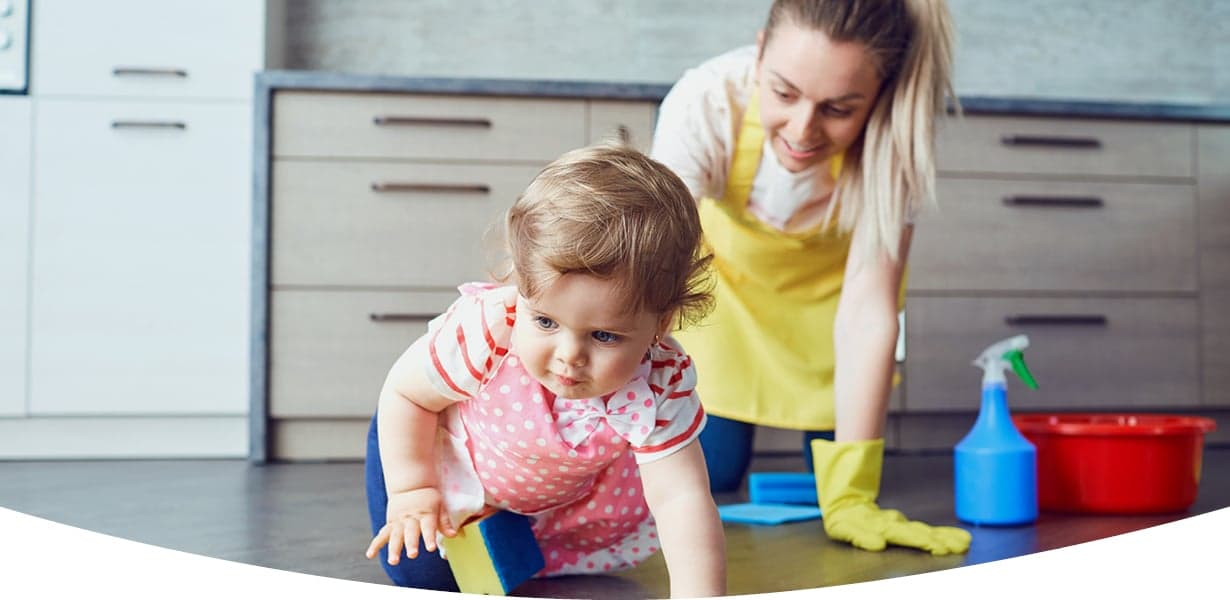
Is cleanliness next to godliness? Tips for parents with babies
The main characteristic of families with small children is that cleanliness is constant even in the apparent chaos. This is especially true during the baby's crawling and creeping developmental stage, when poor mothers clean nonstop to ensure that the curious child’s mouth is not always full of all kinds of inappropriate lint, dirt, hair, and dust bunnies.
But is it possible to clean too much, are the cat-dog-baby face cleaning products baby-friendly, and how much is enough when it comes to cleaning? Tips for parents with babies on maintaining cleanliness at home.
Appearances can be very deceiving
For marketers, it is clear that there is no better target audience than first-time parents, as they are willing to spend on anything if they feel it will benefit their child. Moreover, since they are likely to have more children, they can be nurtured into returning customers. And let's face it, it takes a confident mom and dad to decide what the baby and the family actually need in today's brutal information overload.
It is no coincidence that products aimed at families with small children - especially washing and cleaning products - are heavily overrepresented with baby, animal, cat-dog patterns. These charming shapes, pastel colors, and soft fonts give the impression that the product is specifically made for children or families with children, making their use safe and baby-friendly. However, this is mostly a misconception!

What Makes a Cleaning Product Baby-Friendly?
The main characteristic of truly baby-friendly cleaning products is that they are made from naturally derived plant-based ingredients in an environmentally friendly way, ideally with minimal production of greywater. This not only means that they do not contain, or only contain minimal amounts of preservatives and fragrances, as well as hazardous chemicals like formaldehydes, borates, phosphates, or microplastics, but also that they contain exclusively plant-based, naturally biodegradable surfactants.
Another important criterion is that the product formulas allow for outstanding cleaning performance, providing a real solution against fungi, bacteria, and infections, while no animal testing is conducted during production. The ideal product is also dermatologically tested and comes in recycled, reusable, or recyclable packaging.

Using Traditional Cleaning Products
The popularity of zero waste cleaning products, packaging-free or paper-packaged products is steadily increasing. It's no coincidence! Vinegar, sodium percarbonate, baking soda, lemon juice, or gall soap are cleaning agents with hundreds of years of history, whose use is still just as effective and simple today.
Sodium percarbonate, also known as stain remover salt, is not only a powerful enemy of stubborn dirt and indelible stains embedded in clothes, but also a master of the dreaded grout cleaning. There is simply no cleaning agent more versatile than baking soda: it is an excellent scouring agent, washing and cleaning agent, suitable for deodorizing the fridge, cleaning the toilet, rescuing burnt pots, and even for dishwashing. A true cleaning ace that anyone can easily obtain.
Washing soda, various acetic acids, and time take on even the most fierce enemies, and in many cases, they are the basic ingredients of similar, significantly more well-known products.
How Often Should You Clean When You Have a Baby in the Family?
Good news for mothers who constantly feel bad due to constant self-blame: if there is no illness in the family, it is more than enough to clean the house once a week to maintain a healthy immune system and cleanliness, alongside daily minor tasks.
It is worth keeping in mind that excessive cleanliness, over-disinfection, and constant surface cleaning have the opposite effect of the goals: they weaken the immune system and reduce the ability to resist bacteria and infections. Moreover! The frequent use of overly strong cleaning agents also hides further dangers, as they can lead to the development of stronger, more resistant pathogens in the home microenvironment. So while we try to do something for our family's health, we are actually promoting the development of illnesses.
Let's act sensibly and read the list of ingredients found in cleaning products, get to know the recommendations for each product, and try out packaging-free and zero waste products!
